
Forter's Decision Makers
Most customer stories make the vendor the hero. Forter barely mentioned themselves. What makes this remarkable isn't just the strategy. It's the internal conviction it took to make this happen.

A quick note: Everything I’m sharing here is my subjective take on Forter’s Decision Makers campaign as I’m not privy to their performance metrics or strategy. The recommendations at the end are offered with deep respect for the Forter marketing team and is purely a thought exercise in how I might have approached certain elements differently.
For anyone who hasn't come across them, Forter is a digital commerce trust and fraud prevention platform that helps retailers detect fraud, prevent chargebacks, and approve legitimate customer purchases in real time using identity intelligence and AI. Their buyers are the people who own risk, fraud, and payments inside those businesses. Keep that in mind, because the entire campaign is built around those folks rather than around Forter.
Introducing the Decision Makers
Decision Makers is a customer story program, but calling it that undersells what it actually is. The series spans across several featured customers from companies like Wayfair, eBay, Instacart, and ASICS. Each one is anchored by a roughly 2.5 min mini-documentary and a long-form story that lives on a dedicated domain.
“Oh my gosh, a two-and-a-half minute video?! Nobody has that attention span!” Hold your horses. More on that soon…
There is a dedicated landing page that introduces the concept and the cast, a narrative-setting explainer video that defines a “Decision Maker”, and a clear path that moves a viewer from the video into the deeper written story. The ASICS America story is 3 years old and Forter is still adding to the series. This is not a campaign with a start and end date. It’s a long-term program that’s clearly a key component within their marketing strategy.
Now, I know we marketers tend to use the term “campaign” in nauseam. To clear the air, I simply define a campaign as a focused, time-bound marketing effort designed to achieve a specific goal while a program is an ongoing, repeatable marketing motion that supports a broader objective.
And that concludes this public service announcement.
Here is what makes the execution of this program so fascinating to me. It’s not the production quality or the brand names. It’s what the content chooses to talk about.
The videos walk through a person’s background and personal interests, their career path, a connection between their personal interests and the work of fighting fraud, and finally what it means to them to be a Decision Maker. Forter is mentioned, briefly, near the end.
The stories on the dedicated domain (explore.forter.com) go further into the human being than into the software. They name the person’s spouse, their kids, their dog. They tell you that Deniz Ertan grew up the youngest of three in Turkey, that she won a green card lottery in 2015, that she finds peace in her garden. Forter shows up as the fourth of five chapters, and even then it is handled with restraint.
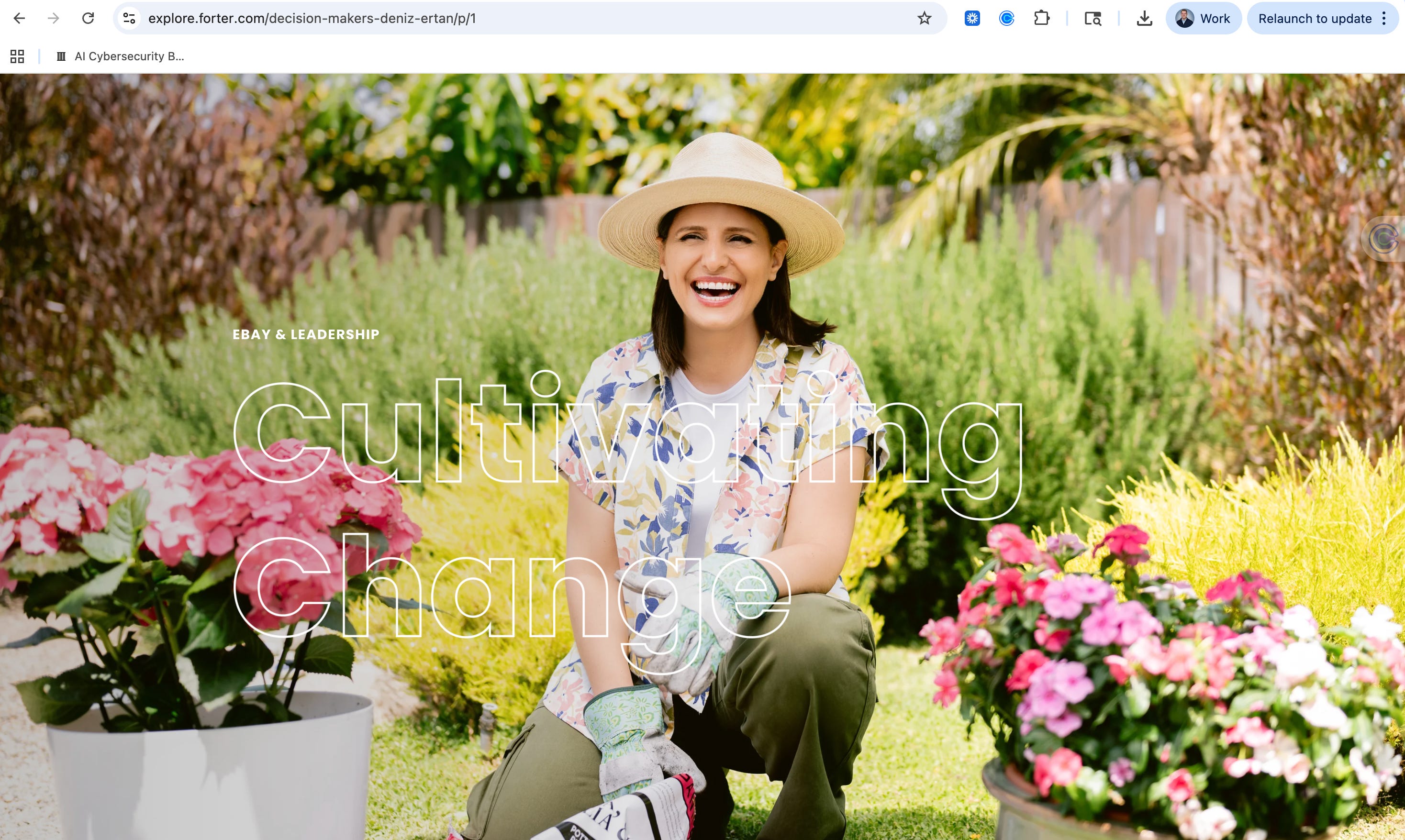
That is the program. A vendor putting considerable budget and time making beautifully produced stories about its customers, in which the vendor is almost absent.
What Was Executed Brilliantly
The central move here is an inversion, and I want to spend time on it because it reframes everything else.
Almost every customer story in B2B is built the same way. The vendor is the hero. The customer is the evidence. The customer appears to validate that the vendor solved their problem, and the structure of the story always bends back toward the product.
Forter flipped the polarity completely.
The customer is the hero, and Forter steps so far out of the frame that you for a moment forget whose program you’re watching. The boldness is not just that they centered the customer. It’s how far they were willing to push it. You don’t make a documentary about someone’s gardening hobby and their immigration story unless you truly value them.
This is where the strategic engine lives, and it’s worth naming precisely.
The fraud and security community is small and highly connected, which means word of mouth is one of the most powerful forces in the market. When a vendor produces something this flattering and this well made about a practitioner, two things happen:
The featured person becomes an advocate, not because they were asked to be but because they were honored, which is a far more durable foundation for advocacy.
And they share it themselves, to their own network, which means Forter’s brand travels through the single most trusted channel that exists in this space: a respected practitioner posting a story that happens to be about them.
That is distribution Forter could never buy directly. The customer carries it, because the content is about the customer.
Underneath the advocacy is a quieter psychological mechanism. By the time you have watched the Deniz video and read her full story, you don’t know her as a customer reference. You feel like you know her as a person. Parasocial familiarity forms before any sales conversation has started, and it transfers. A prospect doesn’t walk away thinking eBay uses Forter. They walk away thinking that people like Deniz use Forter, and that they’d like to be counted among them. That is a meaningfully different thing to plant in a buyer’s mind, and Forter built it on purpose.
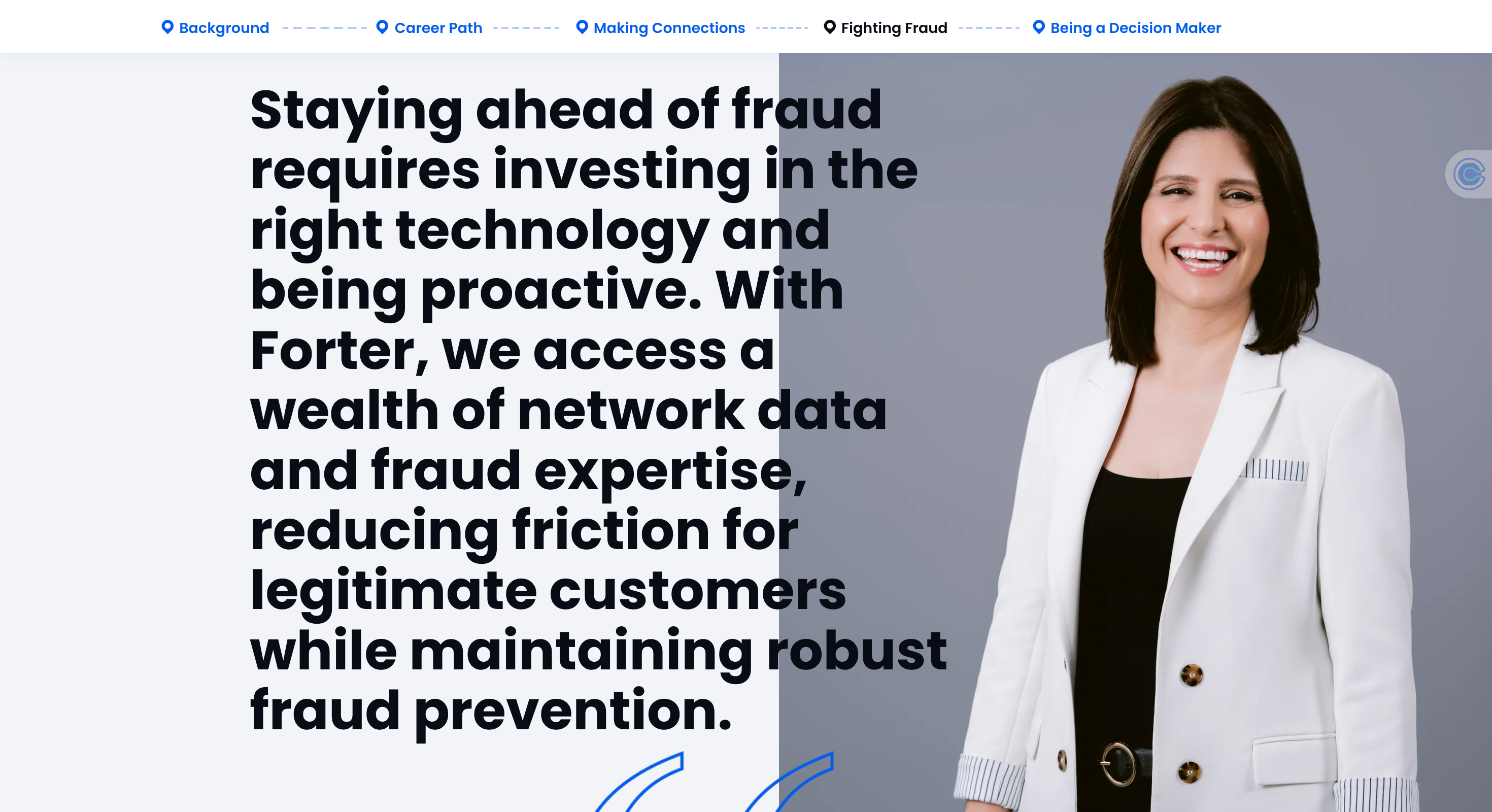
The “Decision Maker” framing itself is the next layer. The hero copy defines a Decision Maker as one of the audacious ones, unconcerned with the status quo, making moves designed to free their teams from the stress of fraud prevention.
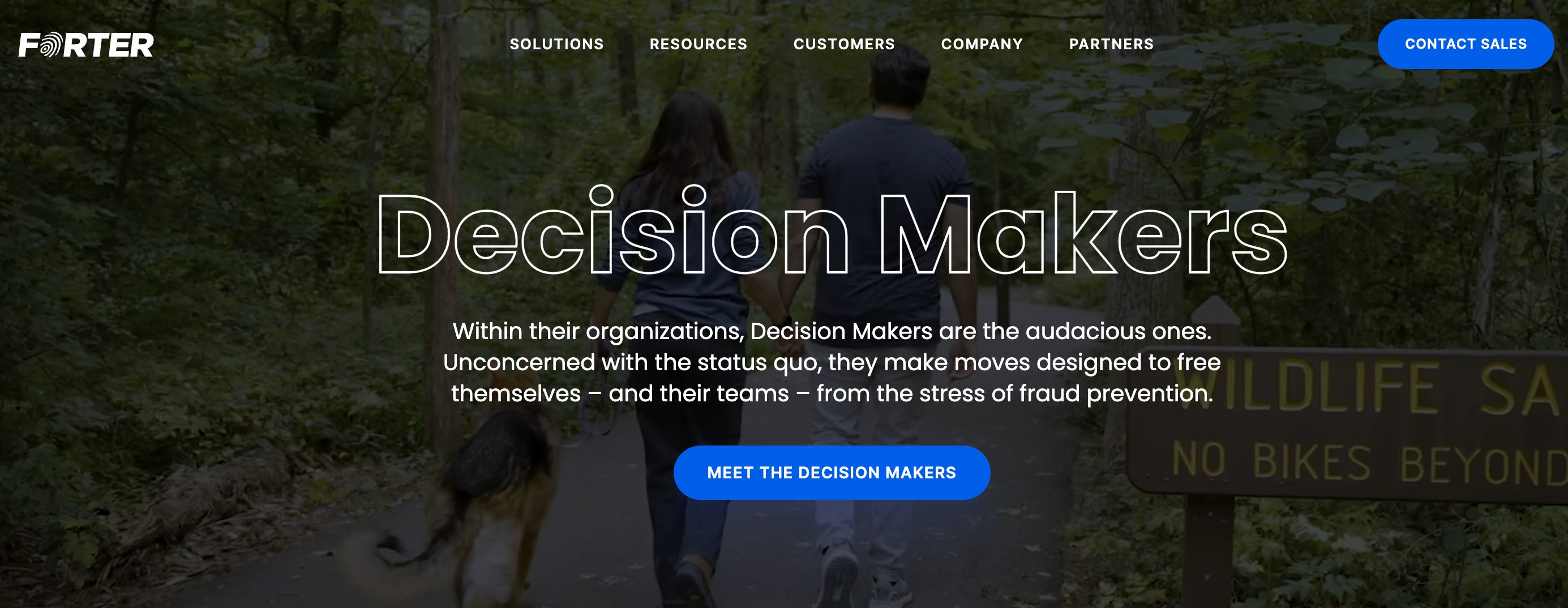
That’s not a description of a job function. It’s a flattering identity, and the campaign is really selling that identity. The bet underneath self-concept theory is that buyers gravitate toward brands that reflect who they want to be, not only the brands that solve a stated problem. Forter is wagering that “I am a Decision Maker” is a self-image its buyers want to claim, and that Forter can become the company that recognized them as such.
The creative device that makes the whole thing hold together is the bridge from a personal interest to the work of fraud prevention. This is the load-bearing move. The story takes something you already find relatable or admirable about a person, the gardening, the cooking, the time on the tennis court, and uses it as the on-ramp to explain why that same person is exceptional at their job. It earns your affection first, then quietly redirects it toward their professional judgment. By the time the connection lands, you are not being told this person is good at fighting fraud. You have been led to feel it.
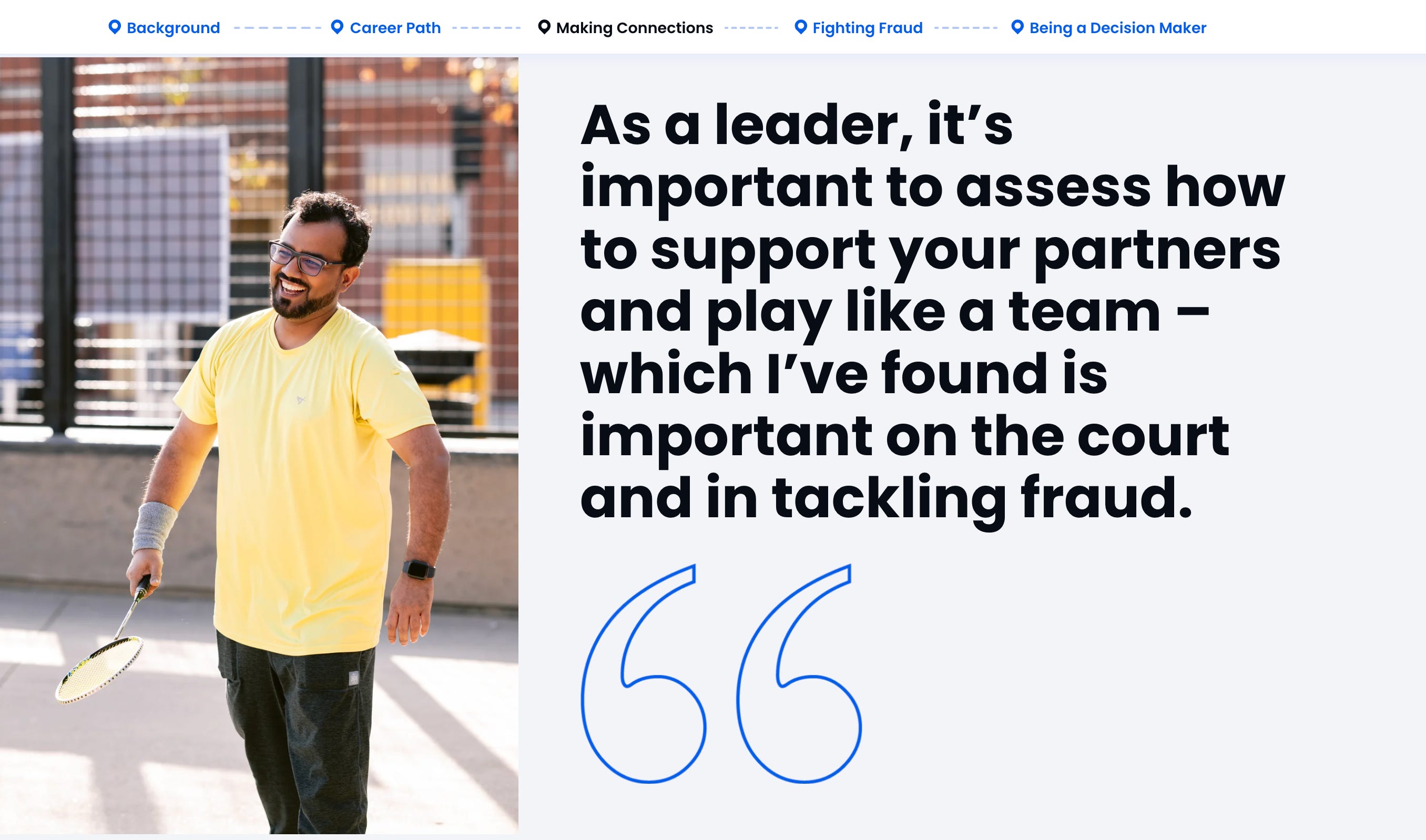
The design of the explore.forter.com landing pages deserves its own mention, because the form is carrying the message. These pages don’t follow the typical design of a SaaS site. There is no feature grid, no logo cloud, no stat band. They read like an autobiography. Oversized chapter headers, full-bleed portraiture, large pull quotes, a chaptered navigation across Background, Career Path, Making Connections, Fighting Fraud, and Being a Decision Maker. That choice changes the reader’s posture before they have processed a single word. We read a biography with our guard down. There is a cognitive fluency angle here worth appreciating: the format is novel relative to the category but deeply familiar as a reading experience, so it feels fresh without ever creating friction. It looks like the kind of thing you make about a person who matters, which is precisely the feeling Forter wants the subject, and every prospect who resembles them, to absorb.
Then there is the call to action that I keep thinking about.
One of the primary CTAs is not “contact sales.” It’s an invitation to submit someone who should be featured as a Decision Maker. Every other call to action in the campaign eventually routes toward a sales conversation. This one routes toward participation. Forter is handing the community a way to honor each other, and in doing so they are proving rather than asserting that they are bought into this community. It also quietly solves the hardest problem in any customer story program, which is sourcing willing and compelling participants. Forter manufactured demand for inclusion. Being named a Decision Maker became something worth being nominated for. That turns the audience into a scouting network and feeds the flywheel from the outside in. A peer sees a story, feels it’s worth celebrating, nominates someone, that person is honored, participates, and shares. The program expands itself.
What I Might Have Explored Differently
Finding things to improve here almost felt disrespectful to the team who built this. It’s just so, so well executed (both at the strategy AND tactical level). But, spurred by a Bloom energy drink, I was able to wrack my brain and come up with a few.
The first is distribution. The individual story videos were clearly distributed through paid, which is why several of them sit in the hundreds of thousands or millions of views. Before I continue, let me just say “Let’s freaking go!” If you’ve followed this newsletter for awhile, you know we frequently run into great campaigns that have not-so-great distribution. I digress…
Those individual story videos are the most impactful assets in the program, because they are the actual stories, and if I had to choose what to put budget behind, I would choose the individual stories every single time. But the narrative-setting explainer video that defines the entire concept, sits at 43 views. That is the piece that names the term and ties all the individual stories together. For a company of Forter’s size, with the budget already evident across this program, leaving the foundational concept video essentially undistributed is the one gap that stands out, precisely because everything around it was resourced so well. You don’t have to choose between it and the individual stories. It is comparatively cheap to put behind the concept that gives the rest of the work its through line.
The second is less a gap and more an appetite the program creates and then leaves unsatisfied. By the end of these autobiography pages, I am fully bought into the person, and I am genuinely curious about Forter. The natural next hunger is to go one layer deeper into the account itself. How does eBay actually use Forter, what did Deniz’s world look like before and after, what changed for her team once the platform was in place. The page resolves into a brief statement about guaranteed results and a “Learn More” button that hands me to the standard sales motion. I would have loved a bridge between this resource and a more comprehensive account-level story, an on-ramp that picks up exactly where the human story ends and rewards the curiosity the program worked so hard to create. Not more product messaging. The restraint is the point. Just one more rung on the ladder for the reader who is leaning in.
And in the same spirit, an idea rather than a critique. After spending this much time falling in love with this program and the people, the most powerful offer Forter could extend is the chance to meet them. This briefly occurred during the Decision Makers Panel at IMPACT 2023, but a recurring in-person component sourced from this program would be legendary.
Local Forter events built around the featured Decision Makers would take the parasocial relationship the campaign so carefully builds and make it real. It extends the work from screen into the room, and it feeds the flywheel again, because an event where prospects meet Decision Makers is itself content, itself word of mouth, and itself a reason to want to be nominated next year.
The Bottom Line
The reason this program sticks with me has less to do with any single asset and more to do with the conviction required to run it at all.
Every marketer reading this has sat in the room where someone asks where the product is. The pull to insert the logo, the feature, the metric, the proof point is relentless, and it usually wins. Forter built an entire program, across several stories and several years, where the product is barely present, and they held that line the whole way. That takes someone senior standing in that room and saying no. No product screen. No feature list. We are going to make something genuinely about these people, and we are going to trust that the value comes back to us.
Lastly, we often say that bold creative is accessible to small teams. Forter is proof of something close to the inverse. Bold restraint is hard for large ones, because large teams carry more stakeholders who want to see the product. Holding that restraint is its own kind of audacity. It is fitting, then, that the program is named for exactly the trait it took to make it. Someone at Forter made an audacious decision, stuck with it for years, and built a program that turns their customers into heroes and their community into a flywheel.
That is the move, and it is one the rest of us should be studying.
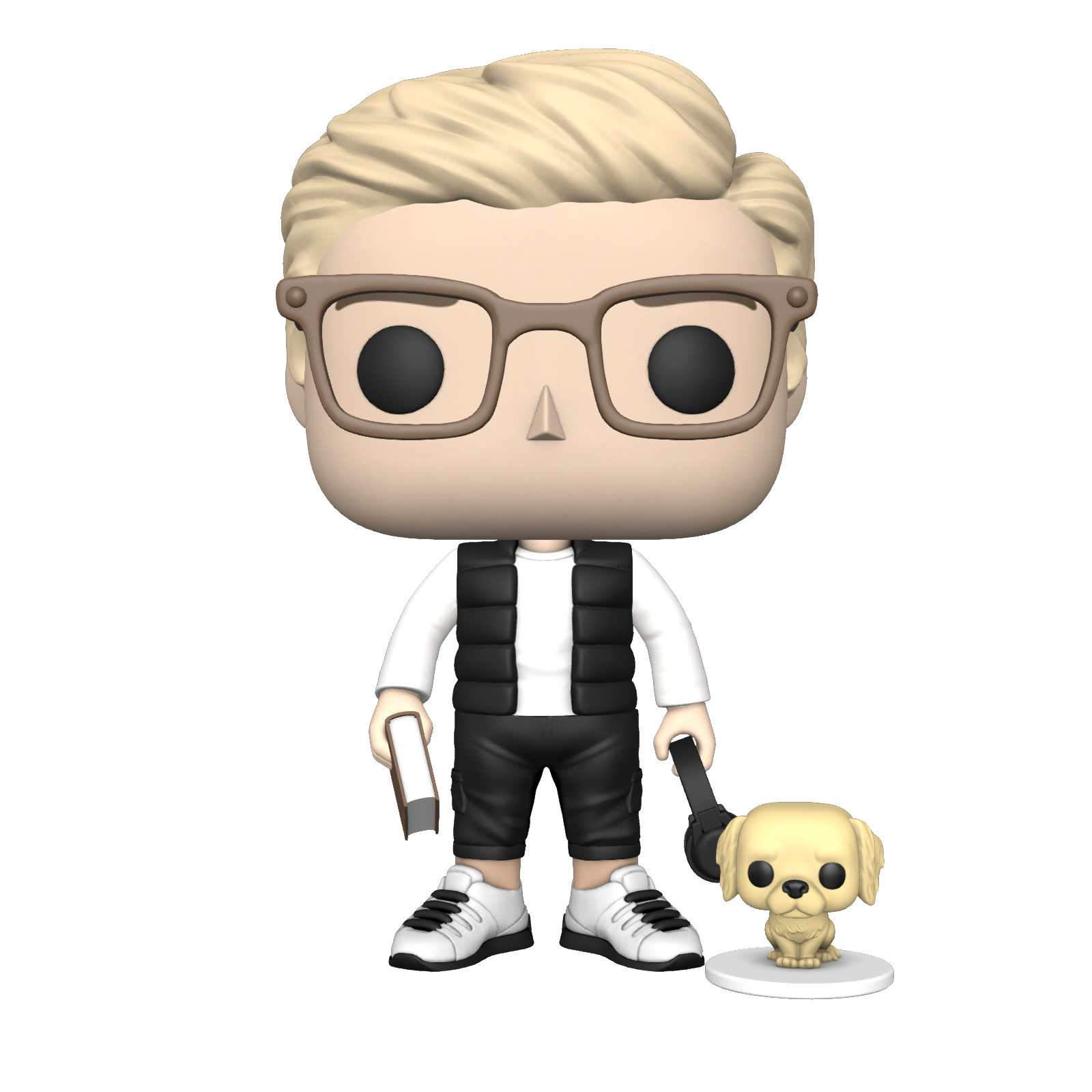
Every week, I write about a marketing campaign in the cybersecurity software space that stands out strategically and/or has creative execution worth studying. And every quarter, I select three “Campaigns of the Quarter” where the marketers who led the campaigns receive a free, personalized Funko Pop. Yes, I’m serious. Here’s mine as proof:
If you’ve led a campaign you’re proud of or know someone who has, message me on Substack or LinkedIn to submit it. I want to see what you’re building.
They either had incredible executive champions and alignment or incredible ROI. What a great program. And thank you for sharing that succinct definition for campaign, that’s going into my notebook.