
Descope's AI Launch Week
We've all faced the same product launch sequencing dilemma: overwhelm your audience, cannibalize your content, or make buyers stitch it together themselves. Descope found a better way.

A quick note: Everything I’m sharing here is my subjective take on Descope’s AI Launch Week campaign as I’m not privy to their performance metrics or campaign strategy. The recommendations at the end are offered with deep respect for the Descope marketing team and is purely a thought exercise in how I might have approached certain elements differently.
Now, let’s talk about launch sequencing.
The Problem Every Campaigns Marketer Knows Too Well
Here’s a scenario I know you’ve lived through. Your product team just shipped something significant. Let’s say it’s a major new capability that solves a significant pain point for your market. Naturally, there are adjacent announcements related to the new capability that need air time to tell the full story. Maybe you’re joining an industry consortium, maybe you’ve got a “Better Together” tech partnership, maybe there’s a technical standards update that matters. And because you’re a marketing team that believes in helping buyers at each stage of their journey, you’ve built out a full-funnel campaign architecture to support this launch: thought leadership pieces, customer stories, webinar demo, technical docs, etc.
The question becomes: How do you sequence all of this? And this question alone, typically creates more confusion than clarity in campaign planning meetings.
I typically see three patterns play out.
Pattern One: You pick a launch day. Everything points to your “hero asset,” the main landing page or blog that describes the new capability. All the adjacent announcements and supporting content are tucked behind an internal linking structure, discoverable only if someone clicks around. The result? Your “hero asset” gets the lime light, but everything else gets cannibalized. Those customer stories you worked so hard on? 10 page views. That partnership announcement? Known only by your partner team.
Pattern Two: You pick a launch day. And launch everything across all channels dispersed over a few hours... Every asset, every announcement, every piece of content goes live on the same day across all of your channels. Your audience gets hit with an info firehose. They’re overwhelmed, they don’t know where to start, and ironically, the abundance of content makes it harder for them to understand what actually matters. There’s research backing up why this fails. Cognitive load theory tells us that working memory can only hold so much info at once. When you dump everything on someone simultaneously, you’re essentially asking them to process more than their brain can handle. Most of it just slides right past them… not to mention if it’s riddled with buzzwords.

Pattern Three: You launch the “hero asset” across all channels on day one, then drip out the supporting content over the following weeks. This feels measured and strategic until you realize you’ve essentially asked your audience to be investigative journalists, stitching together a narrative across multiple weeks with no clear through-line connecting the pieces, especially if all these assets are only connected through internal linking.
None of these are terrible. Marketing teams execute versions of these patterns every day and see reasonable results. But they all share the same fundamental flaw: They treat a complex, multi-faceted launch as if it needs to conform to a single-day news cycle.
Enter Descope’s AI Launch Week Campaign
This is what caught my attention about Descope’s campaign for their Agentic Identity Hub 2.0 launch in January 2026. They made a simple decision: What if a launch doesn’t need to happen in a single day?
Instead of forcing everything into one of the three patterns above, Descope dedicated an entire week to their launch. Five days, each with its own focus. They created a dedicated landing page that housed everything together (see below), organized by day, making it crystal clear that all these pieces were meant to work together to support this launch.

Here’s what that looked like in practice. Day 2 featured top-of-funnel educational content, pieces like “What is CIMD?” and “OAuth DCR Hardening Tips” that help buyers who are still in learning mode. Day 3 was entirely customer stories. The main product announcement about Agentic Identity Hub 2.0 had its big moment, but so did the announcements about joining the Agentic AI Foundation (AAIF) and the Descope-Skyflow integration. Nothing was competing for oxygen. Nothing was getting buried.
The brilliance here is structural. Descope turned their launch into an event, not by adding artificial hype or countdown timers, but by giving themselves the temporal space to tell a complete story. They brought their audience along rather than overwhelming them or making them hunt for context.
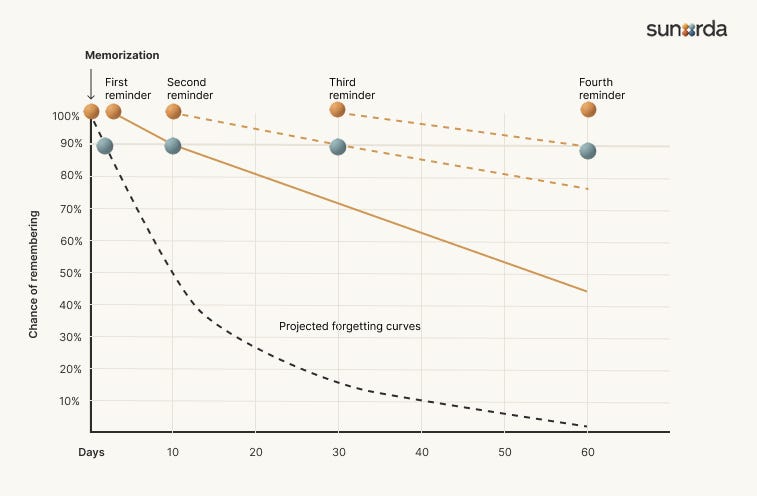
This approach taps into something psychologists have known for decades but marketers often forget to consider. The spacing effect shows that info delivered over time with intervals between exposures leads to better retention and understanding than info delivered all at once. Your brain literally encodes spaced information more deeply. There’s also the mere exposure effect at work here. Repeated exposure to something over several days increases familiarity and comfort with it. By spreading content across five days, each piece gets its own moment to land, and buyers encounter the Agentic Identity Hub 2.0 narrative multiple times from multiple angles. That repetition isn’t redundant. It’s how learning actually works.
The landing page design reinforces this beautifully. Instead of forcing buyers to click link after link to understand how a customer story relates to a technical deep-dive relates to a partnership announcement, everything lives in one place with clear organization. This doesn’t happen often. Most launches rely on internal linking between pages, hoping buyers will follow the breadcrumbs. Descope made the connective tissue explicit.
So here’s my verdict. The strategic framework is sound, the structural thinking is smart, and they did a stellar job organizing complex information. In the next section, I’ll explore potential opportunities to further the impact.
What I Might Have Explored Differently
After studying the campaign, the distribution strategy felt a bit narrow. From my external analysis, distribution seemed to be organic social with employee amplification, one boosted LinkedIn ad, and coverage from a few trade pubs. For a campaign this well-structured, I would have pushed for more aggressive paid distribution. Google Ads ad extensions, YouTube pre-roll, newsletter sponsorships, influencer partnerships. From the outside looking in, it felt like a campaign that deserved louder megaphones. You built a big moment. Make sure people know it’s happening. But again, there is much I don’t have visibility into and I’m not the target audience. The distribution may have been wider than my investigation yielded.
“Marketing just got way more important. We’ve all heard the advice ‘build a product so good that everyone tells their friends’ but when most products are copied, commoditized, and disrupted — distribution will be your only advantage.” - Gaetano Nino DiNardi, Principal Consultant at Marketing Advice
Second, daily themes weren’t clearly communicated on the landing page. I found myself inferring what each day was about rather than being guided through it. What I might have tried: Clear theme headline for each day + end each day’s content with a teaser for tomorrow’s theme. This taps into the Zeigarnik effect, where people remember incomplete tasks better than completed ones. Create a small cliffhanger, and your brain naturally wants closure. Right now, there’s no built-in mechanism to pull you from one day to the next.
Third, the calls-to-action also created friction for me personally. “See for yourself” led to documentation when I expected tutorial videos. “Sign up” offers a free account with no clarity on what’s included. These aren’t campaign deal breakers by any means; simply small fixes that would have a big (and quick) impact.

The last piece is the creative concept question. This campaign was quite direct with no creative wrapper. There’s an argument that a creative theme may have diluted the different messages, but the cybersecurity space is incredibly noisy. Everyone is launching “security for AI” features or products. A distinctive creative concept can be the difference between someone stopping to pay attention and moving past your announcement. Could a creative concept have amplified the technical substance rather than competing with it? We don’t know unless it’s done, but it’s a choice worth interrogating in Descope’s next launch.
The Bottom Line
Descope identified a real problem with how complex launches typically get sequenced, and they designed a format that elegantly solves it. The “Launch Week” structure, paired with a dedicated landing page that creates clear connective tissue between all the pieces, is strong strategic thinking. It respects the audience’s capacity to process information and creates space for every asset to have its moment.
I think this campaign was likely impactful. The framework is sound, the psychological principles are working in their favor, and they clearly put real thought into the user experience. What I see is a campaign that’s a few executional steps away from being truly hard-hitting. Bolder distribution that matches the ambition of the format. Day-to-day momentum that makes the launch feel alive. CTAs that deliver on their promise. And potentially, a creative concept that helps break through the noise.
When you solve a structural problem this cleanly, the opportunity is in the execution. I continue to be genuinely excited about this format. It’s one of the smarter approaches to launch sequencing I’ve seen in cybersecurity marketing lately, and I hope more teams experiment with it and push it even further. Bravo Descope team, bravo.
Every week, I write about marketing campaigns in the cybersecurity software space that stand out strategically and/or have creative execution worth studying. And every quarter, I select three “Campaigns of the Quarter” where the marketers who led the campaigns receive a free, personalized Funko Pop. Yes, I’m serious. Here’s mine as proof:
If you’ve led a campaign you’re proud of or know someone who has, message me on Substack or LinkedIn to submit it. I want to see what you’re building.